Two free tools · Two audiences
One tool answers the teacher.
One answers the student.
Both run inside Google Sheets, start from the Eduphoria export you already pull, and keep student data inside your district's own Google account.
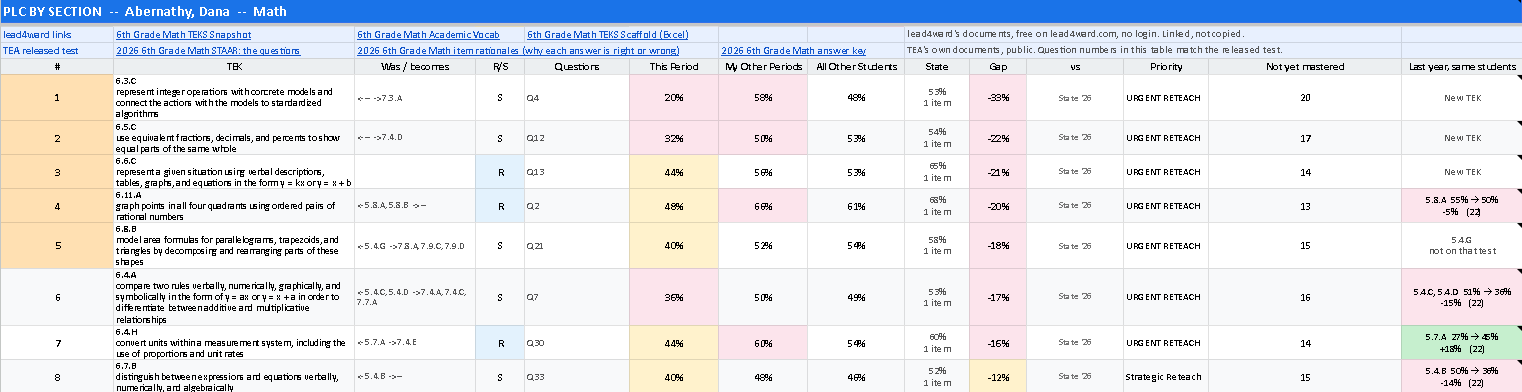
STAAR Analyzer
"What do I do with 3rd period on Tuesday?"
- One tab per teacher, grouped by class period
- TEKS ranked worst-first against a state comparison
- Small groups with the exact questions each student missed
- Students within 15 points of a cut score
- Growth in TEA's 6-by-6 format, with the students behind every cell
- Every STAAR subject, grades 3–8, plus end-of-course tests
Data to Dialogue
"What did I miss, and how close am I to the next level?"
- A one-line personal message for every student
- Their performance level and the questions they missed
- How many questions away they are from the next level
- Whether corrections are required or optional
Want it in your district?
I'll help you get it running.
Free setup help, by email and a short call
No cost and no sales pitch. I'd rather help you set it up than have you guess.
- Email me your district, your role, and which tests you want to run.
- I reply with a few times for a 20–30 minute call.
- On the call we run it together on the demo data, then on your export's header row. No student data is shared with me.
How I build
Built with AI.
Checked against the source.
I'm a classroom teacher, not a software team. I build these tools with an AI coding assistant (Claude Code), and I'm open about which part is mine and which part is the AI's.
What I do
Decide what teachers need. Describe each problem in teacher language. Check every output against TEA's published documents. Push back when a fix misses the real cause.
What the AI does
Writes and rewrites the code. Keeps a decisions log of every design choice and bug. Writes the automated tests.
What the AI never does
Decide what teachers need. See student data. It sees code and column headers only, never a student row.
Fix the start and the end with synthetic data
Invented names and scores give a fixed "before" and "after," so the target stops moving.
Know where north is
Check against what TEA actually published, not what you or the AI assume.
Insist on root cause
A patch that hides the symptom is a bug you'll meet again.
Build it with people
Teachers and administrators have to shape the tool, or they won't use it.
Recent work
Professional development
that respects teachers' time.
Grade Faster with Rubrics in SpeedGrader
A Canvas PD package for a middle school staff with a wide range of Canvas experience. One goal: be a resource and don't waste teachers' time.
- Needs assessment first. A two-minute anonymous survey decided which sessions to build, written so no teacher felt called out.
- One outcome per session. A 15–20 minute "I do / you do" session where every teacher leaves having graded a student with a rubric.
- A safety one-pager. Canvas-to-Skyward Grade Sync overwrites Skyward every night; one page shows teachers how not to lose hand-entered grades.
- A tested AI help assistant. A Gemini Gem that answers only from the PD materials, checked against a 12-question test set until every answer passed.
- Built for the teacher who missed it. Self-teaching slides, plain-language step guides, and one "Start Here" folder.
Background
A teacher who builds systems.
- NowCTE Teacher, Midlothian ISDRobotics, esports, and coding. Supports PLC and data work during my conference period.
- Cleburne ISD6th Grade Advanced Math & RoboticsGrew the robotics program 237%. Built the first version of my data tools and led district data PD.
- Cleburne ISDHigh school esports head coachInstrumental in building and growing the high school esports program.
- Crowley ISD · 2017–2019Algebra I Teacher & PLC Team LeadHighest STAAR passing rate on campus.